
Introduction
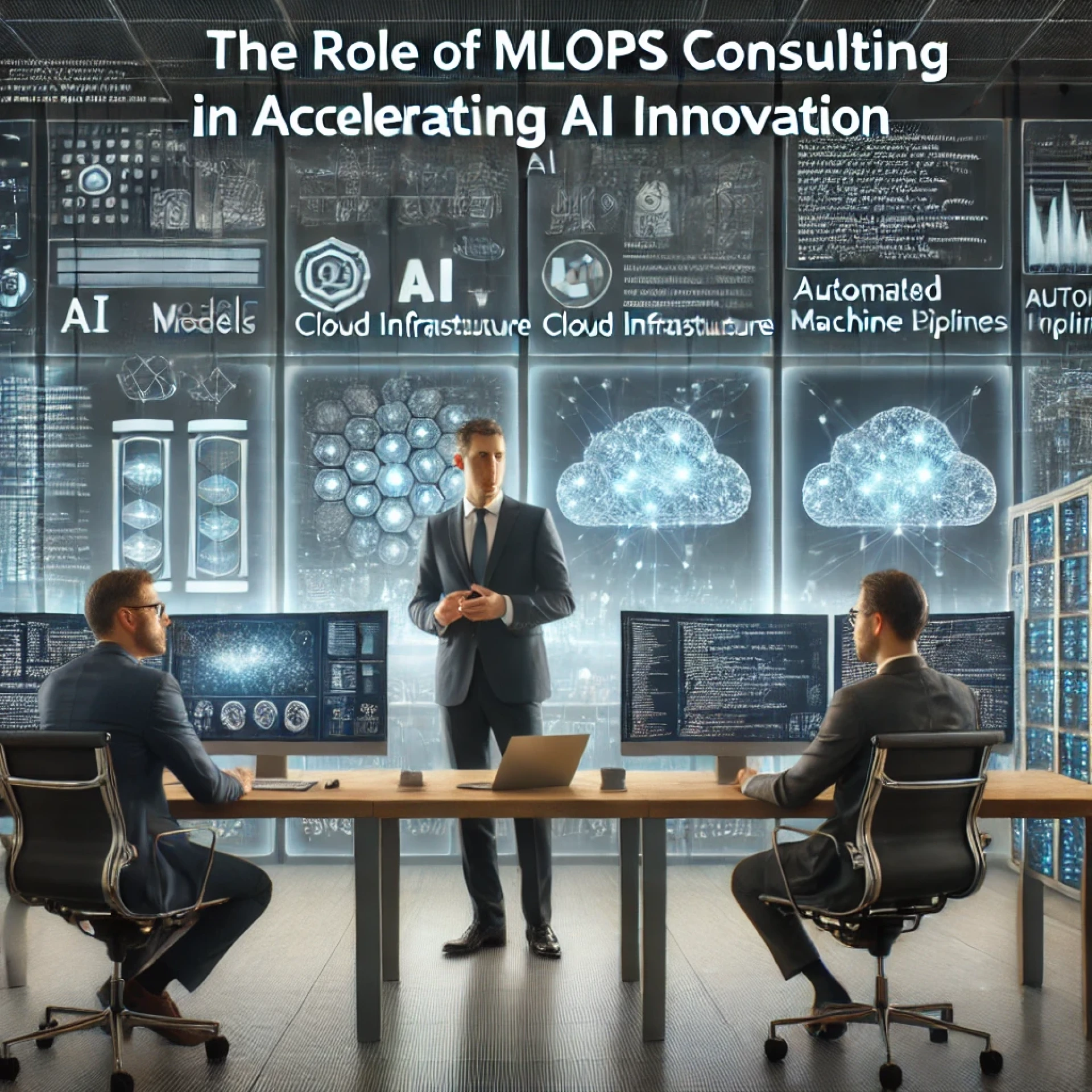
Machine Learning Operations (MLOps) plays a critical role in streamlining AI development and deployment. As businesses adopt AI-driven solutions, ensuring efficiency, scalability, and reliability becomes essential. MLOps consulting services help organizations overcome challenges and build robust AI systems.
Understanding MLOps
What is MLOps?
MLOps is a set of practices that combines machine learning, DevOps, and data engineering. It ensures seamless model development, deployment, monitoring, and governance.
Why is MLOps Important?
- Automation: Reduces manual efforts in managing ML models.
- Scalability: Ensures AI models can handle large datasets and workloads.
- Monitoring: Tracks model performance and prevents drift.
- Compliance: Ensures models meet industry regulations.
- Collaboration: Enhances coordination between data science and engineering teams.
How MLOps Consulting Accelerates AI Innovation
Streamlining AI Model Development
MLOps consultants help organizations structure ML pipelines, automate workflows, and enhance collaboration among data scientists and engineers.
Benefits of a Well-Structured Pipeline
- Faster iteration cycles
- Improved reproducibility of experiments
- Better collaboration across teams
- Reduced operational costs
Enhancing Model Deployment
Deploying AI models at scale is a complex task. MLOps consulting services assist in automating deployment using CI/CD pipelines, ensuring smooth transitions from development to production.
Key Deployment Strategies
- Batch Inference: Running models on bulk data at scheduled intervals.
- Real-Time Inference: Making predictions instantly based on live data.
- Hybrid Deployment: Combining both approaches based on business needs.
- Edge Deployment: Running models closer to data sources to reduce latency.
Ensuring Model Monitoring and Maintenance
Once deployed, AI models require constant monitoring to maintain accuracy and reliability.
Essential Monitoring Metrics
- Model Drift: Detecting changes in data patterns.
- Performance Metrics: Tracking precision, recall, and accuracy.
- Resource Utilization: Ensuring optimal computational efficiency.
- Data Quality: Ensuring the input data remains relevant and accurate.
Scaling AI Infrastructure
MLOps consultants guide organizations in setting up scalable and cost-effective AI infrastructures.
Key Considerations for Scalability
- Cloud vs. On-Premise: Choosing the right infrastructure based on data sensitivity and cost.
- Containerization: Using Docker and Kubernetes for efficient model deployment.
- Automated Scaling: Adjusting resources dynamically based on demand.
- Serverless AI: Leveraging cloud-based solutions to reduce infrastructure management overhead.
MLOps Best Practices for AI Software Development
Data Versioning and Management
Maintaining multiple versions of datasets ensures model reproducibility and reliability.
Tools for Data Versioning
- DVC (Data Version Control)
- MLflow
- Delta Lake
- Apache Airflow
CI/CD for AI Models
Continuous Integration and Continuous Deployment (CI/CD) pipelines automate the ML lifecycle.
Components of CI/CD Pipelines
- Automated Testing: Ensures models meet performance benchmarks.
- Model Registry: Stores approved models for production.
- Rollback Mechanisms: Reverting to previous models in case of failures.
- Version Control: Managing multiple iterations of models.
Security and Compliance in MLOps
Ensuring AI models comply with security and regulatory standards is crucial.
Key Security Measures
- Data Encryption: Protecting sensitive data from breaches.
- Access Control: Restricting access based on roles.
- Audit Logging: Tracking changes for accountability.
- Regulatory Compliance: Meeting industry-specific standards such as GDPR and HIPAA.
Challenges in Implementing MLOps
Organizational Resistance
Many organizations face resistance when adopting MLOps due to lack of expertise or reluctance to change workflows.
Solutions
- Providing MLOps training for teams
- Demonstrating success through pilot projects
- Building a culture of AI adoption
Tooling Complexity
Selecting the right MLOps tools can be challenging due to the vast number of available options.
Recommended MLOps Tools
- Kubeflow for model training and deployment
- MLflow for experiment tracking
- TensorFlow Extended (TFX) for end-to-end pipelines
- Amazon SageMaker for scalable AI solutions
- Azure Machine Learning for enterprise-level model management
Managing Computational Costs
AI model training and deployment require significant computational resources, leading to high costs.
Cost Optimization Strategies
- Using Cloud-Based AI Services to reduce on-premise infrastructure costs
- Optimizing Model Architectures to minimize processing power
- Leveraging Spot Instances for cost-effective cloud computing
- Monitoring Resource Usage to prevent waste.
How to Choose the Right MLOps Consulting Partner
Selecting an experienced MLOps consulting services provider ensures smooth AI integration.
Factors to Consider
- Expertise in AI Software Development: Knowledge of ML frameworks and tools.
- Proven Track Record: Experience in handling real-world AI deployments.
- Customization Capabilities: Ability to tailor solutions to business needs.
- End-to-End Services: Offering consulting, development, deployment, and support.
Questions to Ask Before Hiring an MLOps Consultant
- What industries have you worked with?
- What MLOps tools and platforms do you specialize in?
- Can you provide case studies or references?
- How do you handle model monitoring and maintenance?
Future of MLOps Consulting
As AI adoption continues to grow, MLOps consulting will evolve to meet new challenges.
Emerging Trends in MLOps
- Automated MLOps: AI-driven management of ML pipelines
- Explainable AI (XAI): Ensuring transparency in AI decision-making
- Federated Learning: Training models across decentralized data sources
- AI Ethics and Bias Mitigation: Ensuring fair and unbiased AI models
Conclusion
MLOps consulting helps businesses accelerate AI innovation by streamlining development, deployment, and monitoring. Partnering with the right MLOps consulting services provider enables organizations to build scalable, reliable, and compliant AI solutions.











Sign in to leave a comment.