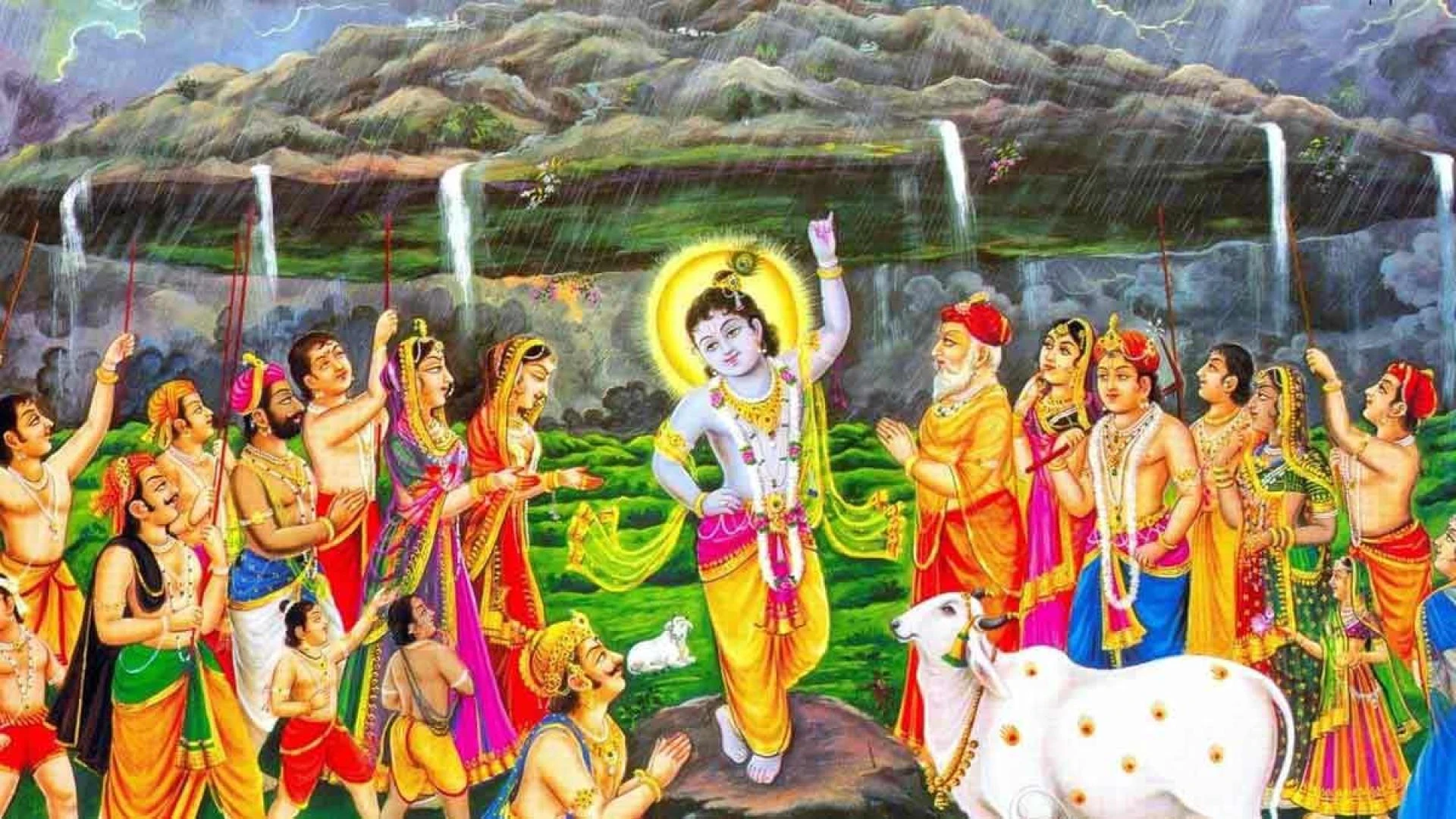

Did you know that in India, people worship a mountain? An interesting story lies behind it.
Diwali is celebrated in India over 5 days. The 3rd day is the main festival, also called Badi Diwali or Lakshmi Pooja. The day after, Hindus perform Govardhan Pooja. Govardhan is the mountain in question, and the story features Lord Krishna, one of the avatars of Lord Vishnu.
It was on this day that Krishna taught a lesson on humility to an arrogant Lord Indra.
Govardhan Pooja History and Significance
One can read the story of how Govardhan Pooja began in the Bhagavata Purana. One day, Krishna asked his foster-father Nanda why the people of Braj worshipped Lord Indra. Braj was in Vrindavan, where Krishna grew up as the foster son of Nanda and Yashoda. His real parents were Devaki and Vasudev of Mathura.
Krishna’s father had taken him as a new-born infant and left him with Nanda in Gokul to protect him from his brother-in-law, Kamsa, who had sworn to kill all the children born to his sister because a divine prophecy had predicted that her 8th child would kill him.
Coming back to the story, Nanda explained to Krishna that they were worshipping Indra to bless them with copious rain so that they could have a good harvest. Without good rainfall, there would be drought, the crops would fail, and famine would be the result. So they had to appease Indra. However, Krishna did not agree with this. He told the villagers that it was due to the Govardhan hill that they got rainfall and not due to Indra. He also advised them to stop worshipping Indra.
The people of Vrindavan adored Krishna. They had seen the miracles he performed even as a toddler, and they had seen his heroic feats against Asuras and the poisonous snake, Kaliya, and so on. They believed what he said and decided to heed his advice. So they did not perform Pooja to Lord Indra that year.
On seeing this, Indra fumed in anger. He wanted to teach the villagers a lesson and make them understand his importance. He made the Samavartaka clouds of devastation pound the village non-stop with rain and thunderstorms. Soon the entire village was flooded. The floods swept away the cattle and other livestock. The people were devastated by the scale of the damages inflicted by the torrential rains.
The panic-stricken villagers ran to Lord Krishna for help and protection. Krishna told them not to worry. He lifted the Govardhan mountain on his little finger and held it aloft like a huge umbrella. The people of Braj and their animals took shelter under the mountain for 7 days. On all 7 days, Krishna didn’t eat anything.
Finally, when he saw that even after days of continuous storms, the people of Gokul were unaffected, Indra conceded defeat and ended the storms.
After this incident, people began to celebrate a festival to honor Mount Govardhan by conducting a \'Giriyajna,\' or a "great offering of food items and delicacies to the mountain". Krishna then took the form of a mountain and accepted their offerings. Indra acknowledged Krishna\'s superiority, as well.
Devotees of Lord Krishna worship him on this day to bless them. They offer him a \'mountain\' of food, which is why food plays an important role in this puja. Apart from that, Lord Krishna\'s worshippers also sing hymns and kirtans, light diyas, and decorate their homes.
Rituals of Govardhan Pooja
Govardhan Pooja is an important part of the Annakut festival, though some Hindu texts consider them to be the same. The Pooja is celebrated in different ways across the country. In South India and Maharashtra, it is Bali Pratiba or Bali Padva. Supposedly, on this day, Lord Vishnu, in the form of the dwarf Vamana, pushed the demon King Bali into Patal Lok.
Devotees bathe early on this day. They clean and decorate the Pooja area and light lamps. The idol of Lord Krishna is bathed in milk and dressed in new attire and ornaments. They also make offerings of his favorite foods. Devotees also sing hymns and kirtans on this occasion. An important ritual is to make a small hill using cow dung and mud. This represents the Govardhan mountain. Devotees worship this hillock as Lord Krishna and the Govardhan parvat and thank them for saving the people of Braj Bhoomi from the wrath of Indra.
Chappan Bhog
It is the custom to offer Chappan bhog, or a ‘mountain’ of food, to Lord Krishna to honor his feat of lifting the mountain for 7 days without eating a morsel of food. In some regions, devotees offer 56 items of food. The math is like this – 7x8 = 56. Krishna usually had 8 meals a day. So, 8 meals on all 7 days make up 56 dishes. This special food offering is called “Annakut”.
The Bhog has to be arranged in a specific sequence, with the milk products arranged very close to the deity. Besan (gram flour) items follow, and then the salty food. Elaichi is offered at the end. 7 types of cereals, 7 types of fruits, 7 types of dry fruits, 7 vegetables, 7 sweets, 7 drinks, 7 namkeen, 7 sauces or pickles (in another variation, it is 16 kinds of namkeen), 20 types of sweets, and 20 kinds of dry fruits are offered as part of Chappan Bhog. Some of the items include spinach, kheer, curd, rice, rasgulla, malpuda, murabba, dalia, jalebi, papad, butter, lassi, kichadi, pakode, lauki (bottle gourd), brinjal, poori, kachori, mango, banana, grapes, almonds, pistachios, saunf, paan, etc.
0




Sign in to leave a comment.