
Introduction: Why VoP Matters
As the European payments ecosystem moves toward instant payments, the risks of fraud, misdirected payments, and operational errors increase. To address these issues, the European Union introduced the Verification of Payee (VoP) service as a key requirement under the Instant Payment Regulation (EU) 2024/886.
VoP is designed to verify the identity of the payment recipient before a credit transfer is authorised, ensuring that funds are sent to the correct beneficiary. This mechanism plays a critical role in enhancing trust, security, and transparency in digital payments.
The regulation mandates that Payment Service Providers (PSPs), Electronic Money Institutions (EMIs), and Payment Institutions (PIs) operating within the Single Euro Payments Area (SEPA) must provide VoP functionality as part of their payment services.
What is Verification of Payee (VoP)?
Verification of Payee (VoP) is a real-time name-checking service that validates whether the beneficiary’s name matches the account details held by the recipient’s bank before a payment is executed.
Core Function
VoP verifies:
- The IBAN (International Bank Account Number)
- The Name of the beneficiary
If the information matches, the payment can proceed with confidence. If not, the payer is warned before authorising the transfer.
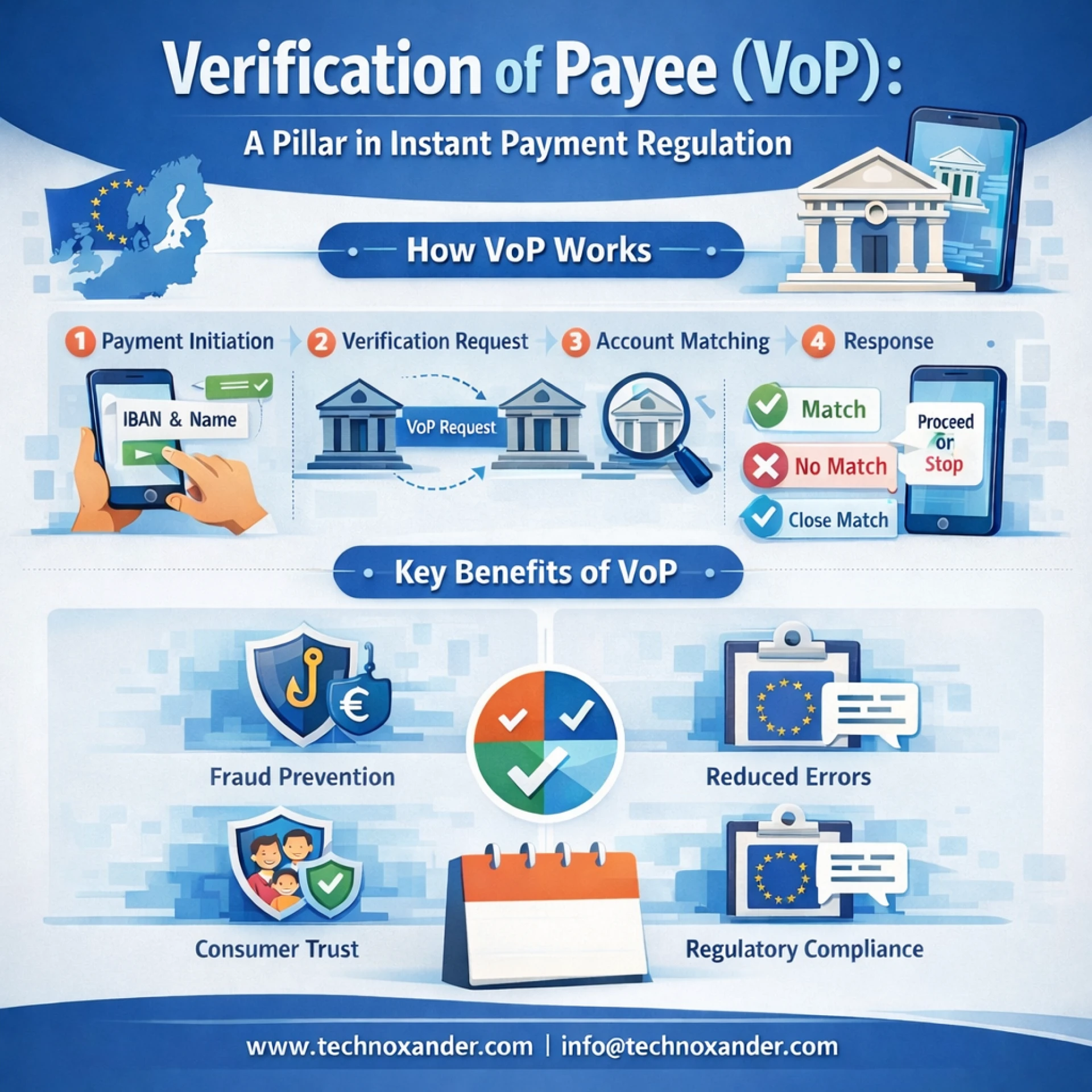
Typical Result Responses
VoP responses usually include:
| Result | Meaning |
|---|---|
| Match | Name and account details match exactly |
| Close Match | Slight variation in name (e.g., abbreviation) |
| No Match | Name does not match the account |
| Unable to Check | Verification could not be completed |
These responses allow the payer to decide whether to proceed with the payment or stop the transaction.
Why VoP is a Pillar of Instant Payment Regulation
Instant payments settle within seconds, leaving very little time to detect fraud or correct mistakes.
VoP addresses this challenge by inserting a verification layer before payment authorisation.
Key Regulatory Goals
The Instant Payment Regulation requires VoP to:
- Reduce Authorised Push Payment (APP) fraud
- Prevent misdirected payments
- Increase consumer trust in instant payments
- Standardise payment verification across Europe
- Enable secure cross-border transactions
VoP therefore acts as a preventive control mechanism within the payment journey, protecting both consumers and financial institutions.
How Verification of Payee Works
The VoP process involves multiple participants within the payments ecosystem.
Step-by-Step Process
Payment Initiation
- The payer enters beneficiary details (name + IBAN).
Verification Request
- The payer’s bank sends a VoP request to the beneficiary’s bank.
Account Matching
- The beneficiary’s bank checks the details against its records.
Response Generation
- A response such as Match, Close Match, or No Match is generated.
Customer Notification
- The payer receives the result and decides whether to continue with the payment.
This process happens in real time and typically within a few seconds, making it compatible with instant payments.
Compliance Timeline
The Instant Payment Regulation introduces clear deadlines for VoP implementation.
Key milestone:
- October 2025 – Mandatory VoP implementation for PSPs operating in the Eurozone.
Financial institutions must ensure their systems support VoP checks before credit transfers are authorised.
Benefits of Implementing VoP
1. Fraud Prevention
VoP helps prevent Authorised Push Payment scams, where fraudsters trick users into sending money to fraudulent accounts.
2. Reduced Payment Errors
Real-time verification ensures that funds are not accidentally sent to the wrong account.
3. Increased Consumer Trust
Customers gain confidence in instant payment systems when verification checks are performed.
4. Regulatory Compliance
Banks can meet EU regulatory obligations under the Instant Payment Regulation.
5. Improved Payment Efficiency
Automation reduces manual verification and operational overhead.
✅ Conclusion
Verification of Payee (VoP) is a foundational element of the Instant Payment Regulation, ensuring that payments are verified before they are executed. By confirming that the payee’s name matches the account details, VoP protects users from fraud and errors while enabling faster and safer digital transactions.
As instant payments expand across Europe, VoP will continue to play a critical role in strengthening trust, compliance, and efficiency within the modern payments ecosystem.
Read More: To visit Original blog post by click here








Sign in to leave a comment.