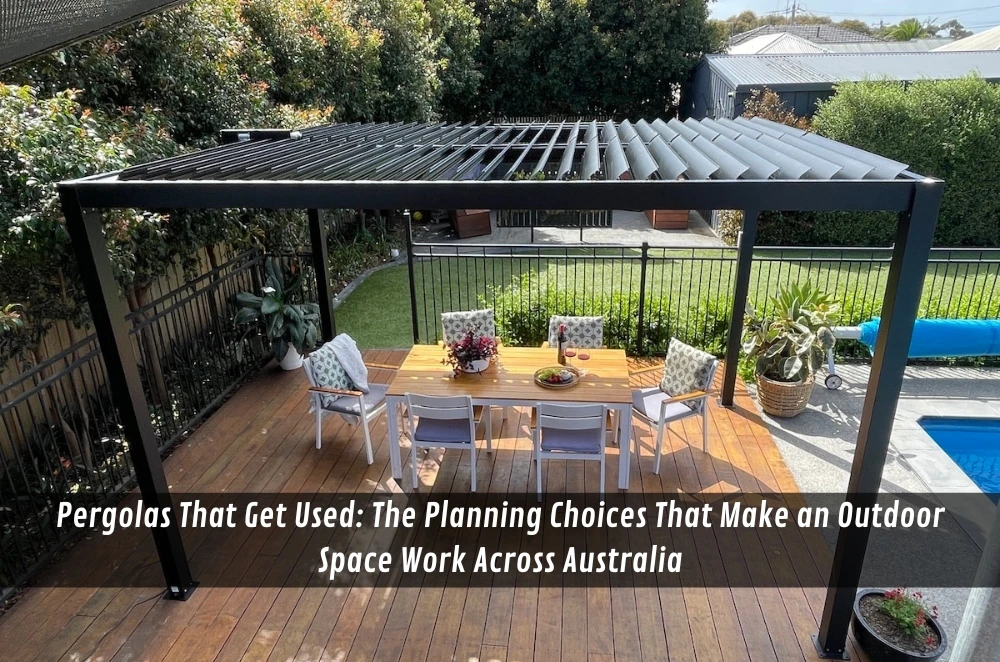

A pergola is one of those upgrades that looks simple until you’re standing in the yard trying to decide where the posts go, how much shade you actually need, and why every quote seems to include different assumptions.
Done well, it becomes the “default room” for weekends, quick dinners, and that extra bit of usable space that makes the house feel bigger.
Done poorly, it becomes a hot, leaky, high-maintenance structure that you avoid for half the year.
This guide is about the decisions that stop a pergola from being “nice in theory” and make it genuinely liveable across Australian conditions.
Why pergolas disappoint after the first few weekends
Most pergola regrets aren’t about style; they’re about comfort and friction.
Comfort problems show up as late-afternoon glare, trapped heat, and rain that blows in from the side you didn’t plan for. Friction problems show up as posts in walk lines, doors opening into awkward spots, and furniture layouts that looked fine on paper but feel cramped in real life.
Then there’s the assumption gap: one plan assumes flat ground and easy footings, another assumes drainage work, another assumes nothing about services, and suddenly you’re not comparing like-for-like at all.
If you want a simple way to sanity-check layout, shade timing, and what’s typically included for freestanding pergola installation in Australia, it helps to review a few standard options before you request quotes.
The decisions that actually matter
1) Shade timing beats shade size
Most people plan for midday sun, but the real comfort killer is often low-angle light at 3–7pm.
Take three or four days and photograph the yard at the times you actually use it. If the entertaining zone is blasted at dinner time, a bigger roof doesn’t automatically fix it; orientation and side protection do.
A pergola can be modest in size and still feel brilliant if the shade lands in the right place at the right time.
2) Posts are a “layout decision”, not a structural afterthought
Mark the walk lines before you mark the posts: back door to BBQ, gate to shed, kitchen to table, path to clothesline.
If posts interrupt those paths, the pergola will feel in the way forever. If posts sit just outside those paths, the pergola feels like it belongs, even if it’s a sizeable structure.
This is also where furniture planning matters: allow space for chairs to pull out, people to pass behind seats, and doors to open without banging into an outdoor “room”.
3) Runoff and drainage need a plan, not optimism
Water will go somewhere, and it often goes somewhere annoying if you don’t choose it.
Even a small roof area can concentrate runoff. Think about where it lands (walkways, garden beds, near the slab edge), and what happens in heavy rain. If the ground slopes toward the house, you want extra care here.
If you’re on reactive clay soils, drainage and footing decisions can become linked—because movement and water management tend to travel together.
4) Wind and airflow are part of comfort
A pergola that blocks breezes can feel stifling. A pergola that catches wind can feel harsh.
This is why “open sides” vs “protected sides” is a real decision. In some yards you want shelter from one direction and openness in another. In others you want a structure that can be adjusted seasonally.
Wind exposure also affects how you position furniture and whether you’ll actually sit in the space on normal evenings.
5) Attached vs freestanding changes more than people expect
Attached structures often feel more like a natural extension of the house, but they can bring extra complexity: roofline integration, water management, and the way the structure connects to existing materials.
Freestanding pergolas can be simpler to position for sun and layout, but they require extra thought about access, lighting, and how you “join” the space to the home visually and practically.
There isn’t a universal best—there’s only what suits your yard and how you live.
If you want a simple way to sanity-check layout, shade timing, and what’s typically included, the nearby pergola specialists across Australia are a useful reference before you request quotes.
Common mistakes
Designing for midday and forgetting 4–7pm. Low sun is what ruins comfort for many homes.
Placing posts before mapping movement. Walk lines should win.
Ignoring where water goes. Runoff becomes a daily annoyance if it hits the wrong zones.
Sizing to the lawn outline, not the furniture. If chairs and circulation don’t fit, the space won’t get used.
Comparing quotes that assume different site work. Drainage, footings, and access are often the hidden differences.
Overcomplicating the first build. The best pergolas are often simple, then improved over time.
Decision factors when choosing an approach and provider
Site constraints and “what’s fixed”
Some constraints are non-negotiable: slope, access, existing paving, service locations, and where doors and windows sit. The best plans accept what’s fixed and design around it, rather than fighting it.
Comfort priorities and trade-offs
Every pergola is a trade: shade vs openness, privacy vs breezes, cover vs light.
Get clear on the top two or three comfort goals, then make decisions that support them. If the goal is “use it more often”, comfort wins over features.
Level of support you actually need
Some owners love managing a build and coordinating. Others just want certainty and fewer moving parts.
Be honest about tolerance for measuring, levelling, and dealing with unknown ground conditions. A structure can look simple, but the outcome depends heavily on early site decisions.
Practical opinion: Shade timing matters more than roof size.
Practical opinion: Posts should protect walk lines, not interrupt them.
Practical opinion: Runoff planning is part of comfort, not “extra”.
Operator Experience Moment
The most common pergola regret is hearing, “It looked perfect on the plan, but we don’t sit there.” Usually the shade lands slightly off the dining zone, or the posts ended up right in the movement path between the house and the yard. When the layout is tested with tape and furniture first, the build becomes obvious instead of guessy.
A simple first-actions plan for the next 7–14 days
Days 1–2: Photograph sun and note real use
Take quick photos at 9am, midday, 3pm, and 6pm, and write down when the space is actually used.
Days 2–4: Tape out the layout and walk it
Mark a rough pergola footprint with tape or pegs, place the “table zone”, and walk your normal routes through it.
Days 3–6: Check slope, runoff, and wet spots
After rain (or after hosing), note where water pools and where it runs. These notes affect both runoff planning and footing discussions.
Days 5–8: Lock your top three priorities
Examples: “shade over dining at 5pm”, “keep side passage clear”, “avoid runoff toward house”, “maintain airflow”.
Days 7–10: Request quotes with the same brief
Share the same photos, footprint sketch, and priorities so assumptions are aligned and quotes are actually comparable.
Days 10–14: Confirm post positions and the “finished look”
Decide where lighting would go later, how you’ll route water, and how the pergola connects visually to the house (without forcing it).
Local SMB mini-walkthrough
A small landscaping team can help mark walk lines and furniture zones before anything is ordered.
A local concreter can flag footing complexity early when the ground is sloped or reactive.
A builder can sanity-check how attached structures integrate with existing roof and runoff paths.
An electrician can pre-plan lighting and fan positions so you’re not cutting into finished work later.
A drainage specialist can advise where concentrated runoff should go in heavy rain.
Across Australia, good outcomes come from sequencing the right advice before the structure is locked in.
Key Takeaways
- Plan for 3–7pm comfort, not just midday shade.
- Protect walk lines and furniture circulation before choosing post positions.
- Treat runoff and drainage as core scope items, not afterthoughts.
- Compare quotes only when site assumptions and inclusions are written clearly.
Common questions we hear from businesses in Australia
Do pergolas always need council approval?
Usually, it depends on your local council area, the size/height, and whether the pergola is attached or freestanding. A practical next step is to check your local requirements early so design decisions don’t get reversed later. In many Australian suburbs, approvals vary street-by-street and by property type.
How do we stop the pergola area feeling too hot?
In most cases, it depends on orientation, airflow, and whether low-angle sun is controlled. A practical next step is to map late-afternoon sun and design shade to land over the seating zone at 4–7pm. In hot Australian summers, cross-ventilation often matters as much as roof coverage.
Why do quotes vary so much for “the same” pergola?
Usually, it’s because footings, drainage, access, and inclusions differ—even if the roofline looks similar. A practical next step is to issue one brief with photos, footprint, and site notes so each provider prices the same assumptions. Across Australia, ground conditions are a major hidden driver of scope.
What’s the best way to avoid posts ending up in awkward spots?
In most cases, you avoid it by taping out the footprint and walking the space like it’s a normal day—door to BBQ, gate to bin area, path to clothesline. A practical next step is to mark those walk lines first and keep posts out of them. In smaller Australian yards, post placement mistakes are felt immediately.










Sign in to leave a comment.