

Search engines reward writing that helps a real person finish a real task. When text sounds mechanical, readers bounce, links vanish, and rankings soften. This guide shows you how to reduce robotic tone in AI content while meeting modern SEO expectations. You will learn why tone affects engagement signals, how to revise drafts for clarity and voice, and where Easy AI Checker fits into a repeatable workflow.

Why robotic tone hurts rankings in 2026
Modern ranking systems model user satisfaction. They observe dwell time, scroll depth, pogo sticking, and task completion metrics. Mechanical writing disrupts comprehension and weakens trust, which lowers these user signals. A human reader expects varied sentence openings, precise nouns and verbs, and transitions that explain why a statement follows, not just that it does. When text delivers those elements, it feels natural, which increases the chance of longer sessions, internal clicks, and return visits.
The simple formula behind human-sounding AI copy
A natural voice comes from three controllable layers:
- Intent clarity: Each section must solve a specific user question.
- Line level rhythm: Sentences should mix short and medium lengths with occasional longer lines that carry nuance.
- Evidence density: Concrete examples, numbers, and steps replace filler.
If you address those layers in that order, your pages will sound more like a careful expert and less like an auto-generated summary.
Set a clear intent for every page.
Before you edit tone, confirm the page’s job. Write one sentence that defines the reader, the problem, and the desired outcome. For example, “This article helps marketing managers fix flat-sounding product pages by adding benefits, examples, and comparisons.” Place the outcome in your introduction so readers know what they will achieve. Clear intent reduces hedging language and repetitive phrasing that often triggers a robotic feel.
As you structure the piece, place a few long tail phrases naturally inside the headings and paragraphs. A line that explains how to make AI writing sound human signals relevance without stuffing. Your text stays focused, and indexing benefits from the explicit match to user phrasing.
Align tone with brand voice.
Robotic tone often appears when drafts mix styles. Create a one-page voice brief that answers three questions. How formal should the writing be? Which words fit the brand? What is off limits? Then add common transformations that apply to every page:
- Convert passive constructions to active when responsibility matters.
- Replace intensifiers with precise details.
- Prefer verbs over abstract nouns.
If you run a publication with multiple authors, store a living checklist titled brand voice alignment for AI content. It can include preferred terms, neutral alternatives, and banned clichés. The checklist keeps teams consistent and prevents a drift back into generic language.
Build a question-led outline.
Readers scan first, then decide whether to commit. An outline that mirrors real questions creates a natural flow and reduces robotic transitions. Draft H2 headings that reflect outcomes. Under each H2, add H3 prompts that represent subtasks. For example:
- H2: Identify robotic tone in your current draft
- H3: Spot repetition and over-templated phrases
- H3: Check cadence and connective tissue
- H2: Rewrite for voice and clarity
- H3: Replace abstractions with examples
- H3: Balance sentence length and openers
A structure like this reduces filler and helps you edit generated text for clarity without sacrificing depth.
Tackle the top robotic patterns first
Four patterns account for most of the stiffness in AI drafts.
- Repetitive openings: Consecutive sentences that all start with the same subject or transition feel machine-stitched. Vary with prepositional, adverbial, or participial openers. A recurring reminder, like reducing repetitive sentence starters in AI, keeps this fix top of mind.
- Weak verbs and heavy nominalizations: Replace “make an improvement to” with “improve.” Swap “provide a reduction in” with “reduce.” Strong verbs shorten lines and improve rhythm.
- Stacked qualifiers: Phrases such as “very, really, quite, highly” pad sentences without adding meaning. Replace them with specifics.
- Unexplained jumps: Insert connecting phrases that show cause, contrast, or sequence. Words such as “because,” “however,” and “therefore” guide the reader through the logic.

Show, then tell
Robotic copy describes concepts without anchoring them in reality. Use small demonstrations. Present the unedited line, explain the issue, and show the fix.
Original: “The tool provides the ability to create significant improvements in readability for your content production workflows.”
Issue: Nominalizations, filler words, and a vague subject hide the action.
Rewrite: “The tool improves readability in your content workflow.”
Readers learn faster when they see the exact transformation. Repeating this micro pattern across a page builds momentum and makes your expertise obvious.
Calibrate sentence length and cadence
Natural text uses a mix of lengths. Short lines create punch. Medium lines carry detail. Longer lines group connected thoughts when they belong together. Read each paragraph aloud. If it sounds breathless, merge two short sentences. If it sounds muddy, split a run on a line. Apply this test section by section until the rhythm feels smooth.
While tuning, measure readability without chasing a single number. For quick diagnostics before deeper editing, try the free AI Checker in Easy AI Checker to flag robotic phrasing and awkward cadence. Your aim is clarity for the intended audience, not a generic grade. During this pass, make sure you improve the readability score of AI text by reducing redundancy, trimming nested clauses, and guiding the eye with organized lists.
Match content to search intent
A page that answers the wrong question always sounds off. Map the dominant intent behind your query. If users want a how-to guide, give them steps and checkpoints. If they want comparisons, provide a selection framework and criteria. When intent alignment is strong, the writing becomes specific and the robotic tone fades.
Intent work pairs well with context-aware rewriting for search intent. Replace generic promises with actions that resolve the user’s next move. The result reads like a helpful conversation rather than an abstract essay.
Add evidence and ethical guardrails.
Trustworthy pages contain verifiable details. Include small data points, brief case snippets, or named methodologies. Disclose limits and tradeoffs when appropriate. Establish a simple policy for ethical humanization of AI drafts so your team avoids misrepresentation and meets evolving guidelines. Ethical clarity increases user confidence and keeps your tone grounded.
The practical five-pass rewrite workflow.
Use this loop to refine any AI draft into a natural, high-performing article. It is short enough for individual creators and robust enough for teams.
- Intent pass: State the reader’s problem and promised outcome in one sentence at the top of the draft.
- Structure pass: Convert the outline into question-led H2 and H3 headings that mirror a real reading journey.
- Voice pass: Apply the brand checklist and change weak verbs, passive voice where inappropriate, and abstract nouns.
- Clarity pass: Insert examples, define acronyms at first mention, and explain transitions that leap too far.
- Cadence pass: Vary openings, balance lengths, and remove repetitive phrases.
After the fifth pass, your article should already feel human and helpful. Now you are ready for quality assurance.
Validate and iterate with Easy AI Checker.
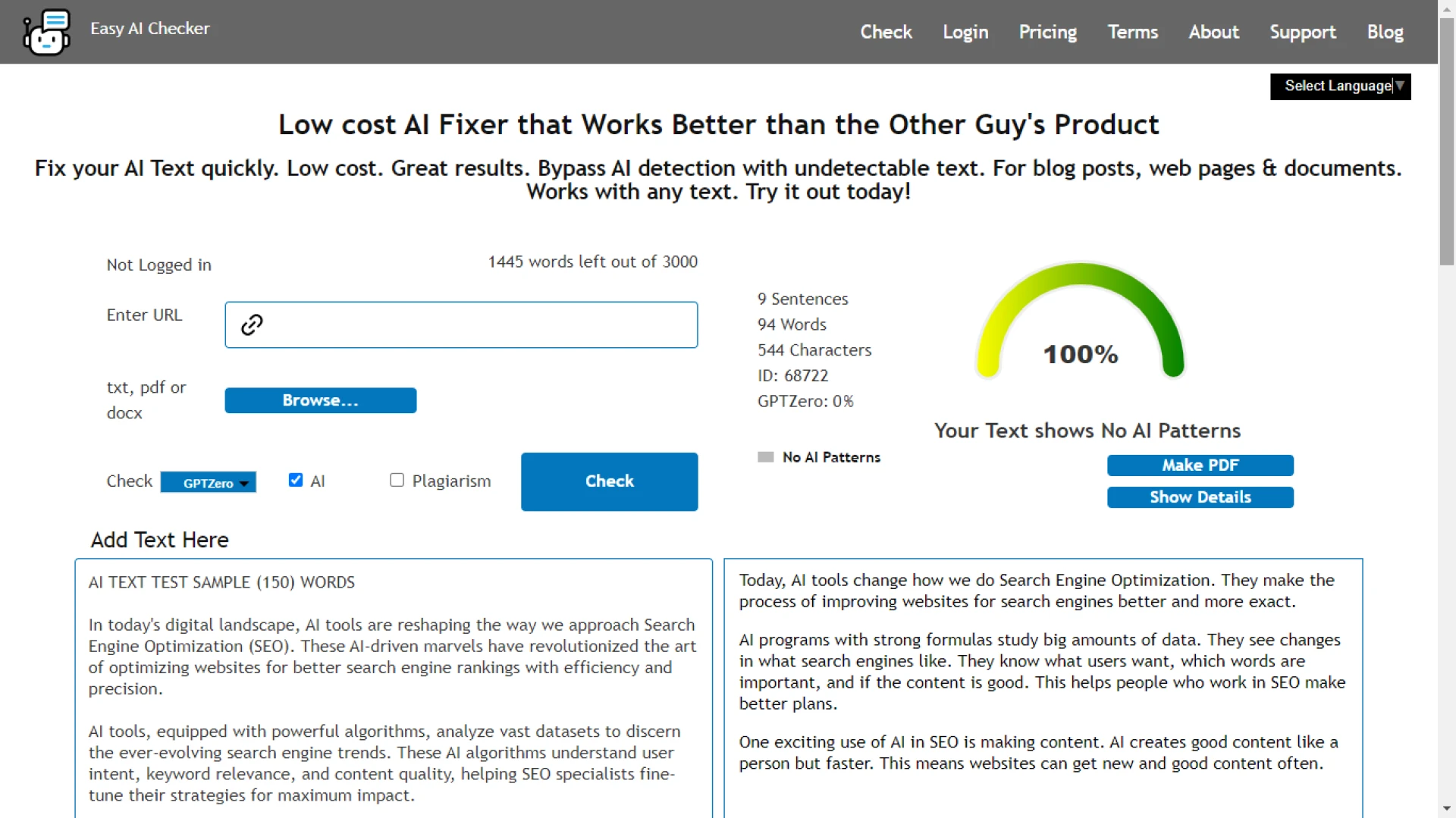
One tool can organize your final checks without bouncing between multiple dashboards. Easy AI Checker helps you locate stiff phrasing, redundant transitions, and under-explained sections in a single place. Follow this workflow:
- Paste or upload your draft. Run an initial scan to flag mechanical patterns and tone inconsistencies.
- Review the suggestions and apply targeted improvements. Focus on rhythm, voice alignment, and clarity.
- Verify that your text addresses search intent and supports the promised outcome.
- Run a second scan to confirm progress and catch residual issues.
- Save a brief changelog that records what you refined. This habit improves future drafts and creates editorial transparency.
Because the tool focuses on flow and readability, it pairs naturally with the keyword placements you introduce for SEO. It also supports teams that must standardize tone across a large library of pages.
On-page SEO details that reinforce natural tone
Technical and editorial elements work together. Use this short checklist before you publish.
- Title and H1: Keep the core idea, along with the focus phrase, within a sensible length for pixel limits.
- URL slug: Keep it short and descriptive, such as /reduce-robotic-tone-ai-content.
- Introduction: Explain the reader’s goal and the outcome in the first paragraph.
- Heading hierarchy: Use H2 and H3 with descriptive labels that reflect questions.
- Internal links: Point to cornerstone content using precise anchors rather than generic “click here.”
- Image alt text: Describe purpose and context, not just appearance.
- Schema: Add Article or HowTo markup when appropriate.
- Calls to action: Invite a single next step, such as validating the final draft with Easy AI Checker.
- Readability: Keep paragraphs digestible and transitions explicit.
- Maintenance: Schedule quarterly reviews to refresh examples and intent coverage.
These elements ensure that seo friendly human writing tips 2026 are present throughout the page without overwhelming the reader.
Example transformations you can reuse today
Try these small edits on your next draft.
- Replace “there is” and “there are” openings with concrete subjects.
- Swap filler adjectives for specific descriptors that carry information.
- Convert list items into parallel grammatical forms.
- Use cause and effect transitions to reduce whiplash between sentences.
- Turn vague claims into steps that someone can follow this afternoon.
Repeat these choices across the page, and tone improves quickly.
Maintenance that preserves voice over time
Natural tone is not a one-time achievement. Revisit high traffic pages quarterly. Compare user questions from search console data with your outline. Use those insights to humanize AI-generated text for SEO by echoing the exact phrases readers use and clarifying steps they repeatedly miss. If readers linger on a subsection, expand it. If an example no longer reflects current practice, update it. Each improvement strengthens authority and keeps the voice consistent.
Run Easy AI Checker during these refresh cycles so the library stays coherent across authors and months.
Conclusion
You can reduce robotic tone in AI content by clarifying intent, tuning rhythm, backing claims with evidence, and validating the final draft with Easy AI Checker. Follow the five-pass rewrite workflow, align to brand voice, and keep your SEO elements supportive rather than intrusive. When readers feel understood, they read longer, act more often, and return more frequently. Those behaviors are the strongest signals you can send for rankings in 2026.













Sign in to leave a comment.