
Smart grids generate massive amounts of data every second. Sensors, meters, and monitoring devices scattered across vast networks collect information that needs to travel from edge locations to central data centers—reliably, securely, and without disruption.
Managing this constant data flow presents a significant challenge. Traditional storage solutions often fall short when handling the volume, velocity, and security requirements of modern smart grid operations. Network-attached storage (NAS) systems offer a proven approach to synchronizing data across distributed grid infrastructure while maintaining the security standards that utility companies and energy providers demand.
This article explores how enterprise NAS solutions address the specific needs of smart grid networks, from edge data collection to core processing and analysis.
Understanding Data Synchronization Challenges in Smart Grids
Smart grids operate across geographically dispersed areas with thousands of connection points. Each substation, transformer, and monitoring device collects operational data that must reach central systems for analysis and decision-making.
The challenge lies in maintaining data integrity while moving information across multiple network layers. Edge devices capture real-time readings, but network connectivity can be inconsistent. Data must queue safely at collection points until transmission is possible, then sync accurately with core systems once connectivity resumes. NAS systems play a critical role in this process by providing reliable, centralized storage at aggregation points, ensuring buffered data is preserved and synchronized without loss or corruption.
Power utilities also face strict regulatory requirements around data retention and security. Information about grid performance, customer usage, and system health cannot be lost or compromised during transmission. Any storage solution must handle these demands while scaling to accommodate growing data volumes as grid monitoring becomes more granular.
Why Do NAS Systems Fit Smart Grid Requirements?
NAS systems excel at managing distributed data workflows because they're purpose-built for network environments. Unlike direct-attached storage that serves a single system, enterprise NAS creates centralized storage pools accessible across the network—perfect for collecting data from multiple edge locations.
Modern NAS appliances offer several advantages for smart grid applications:
Scalability: Storage capacity expands by adding drives or scaling out with additional NAS units. As smart grids deploy more sensors and monitoring equipment, storage infrastructure grows in step.
Redundancy: RAID configurations and backup systems protect against drive failures. If hardware malfunctions, data remains accessible and no information is lost during transmission from edge to core.
Network Optimization: NAS systems include features specifically designed for efficient data transfer across networks, such as compression, deduplication, and bandwidth management protocols that prevent network congestion.
Cost Efficiency: Compared to enterprise SAN infrastructure, NAS provides robust storage capabilities at a lower total cost of ownership—an important consideration for utility companies managing extensive physical infrastructure.
Implementing Edge-to-Core Data Synchronization
A typical smart grid deployment places NAS systems at both edge and core locations. Edge NAS units serve as local collection points, gathering data from nearby sensors and devices. These systems temporarily store information and manage the initial data processing before transmission to central facilities.
At the core, larger enterprise NAS configurations receive synchronized data from all edge locations. This centralized storage serves as the foundation for analytics, reporting, and long-term archival requirements.
The synchronization process typically follows these steps:
- Collection: Edge devices write data to local NAS storage as it's generated.
- Queuing: NAS systems buffer data when network connectivity is limited or bandwidth is constrained.
- Transmission: Once network conditions allow, NAS systems initiate data transfer to core storage using scheduled or event-triggered protocols.
- Verification: Core systems confirm successful data receipt and integration, allowing edge systems to clear local buffers.
This approach ensures no data loss occurs due to network interruptions while optimizing bandwidth usage across the grid network.
Protecting Smart Grid Data Against Ransomware
Energy infrastructure has become a prime target for cyberattacks. Ransomware incidents affecting utility companies have increased significantly, with attackers specifically targeting operational technology and data storage systems.
NAS appliances ransomware protection features have evolved to address these threats through multiple defensive layers:
Snapshot Technology: Modern NAS systems create point-in-time snapshots of data at regular intervals. If ransomware encrypts files, administrators can restore from clean snapshots taken before the attack. This recovery capability is essential for maintaining grid operations when security incidents occur.
Immutable Backups: Some enterprise NAS solutions support write-once-read-many (WORM) configurations that prevent any modification or deletion of archived data—even by administrators with elevated privileges. Attackers cannot encrypt or destroy these protected copies.
Access Controls: Granular permission systems limit which users and systems can access specific datasets. Even if attackers compromise one segment of the network, properly configured NAS systems prevent lateral movement to other storage areas.
Network Segmentation: NAS deployments often incorporate isolated network zones for critical data. Edge systems operate on separate subnets from core infrastructure, containing potential breaches at the perimeter.
Anomaly Detection: Advanced NAS platforms monitor file access patterns and flag unusual activity that might indicate ransomware encryption processes, allowing security teams to respond before significant damage occurs.
These protections work together to create resilient storage infrastructure that can withstand and recover from security incidents without disrupting grid operations.
Performance Considerations for Real-Time Grid Monitoring
Smart grids require near-real-time visibility into system status. Operators need current information to balance loads, detect faults, and respond to changing demand patterns. Storage systems must deliver data quickly enough to support these operational requirements.
Enterprise NAS solutions address performance needs through several mechanisms:
SSD Tiering: Hybrid configurations combine solid-state drives for frequently accessed data with larger capacity spinning drives for archival storage. Recent grid readings stay on fast media while historical data moves to cost-effective long-term storage.
Caching: Intelligent caching algorithms predict which data will be requested and keep it readily available in memory, reducing retrieval latency for monitoring dashboards and control systems.
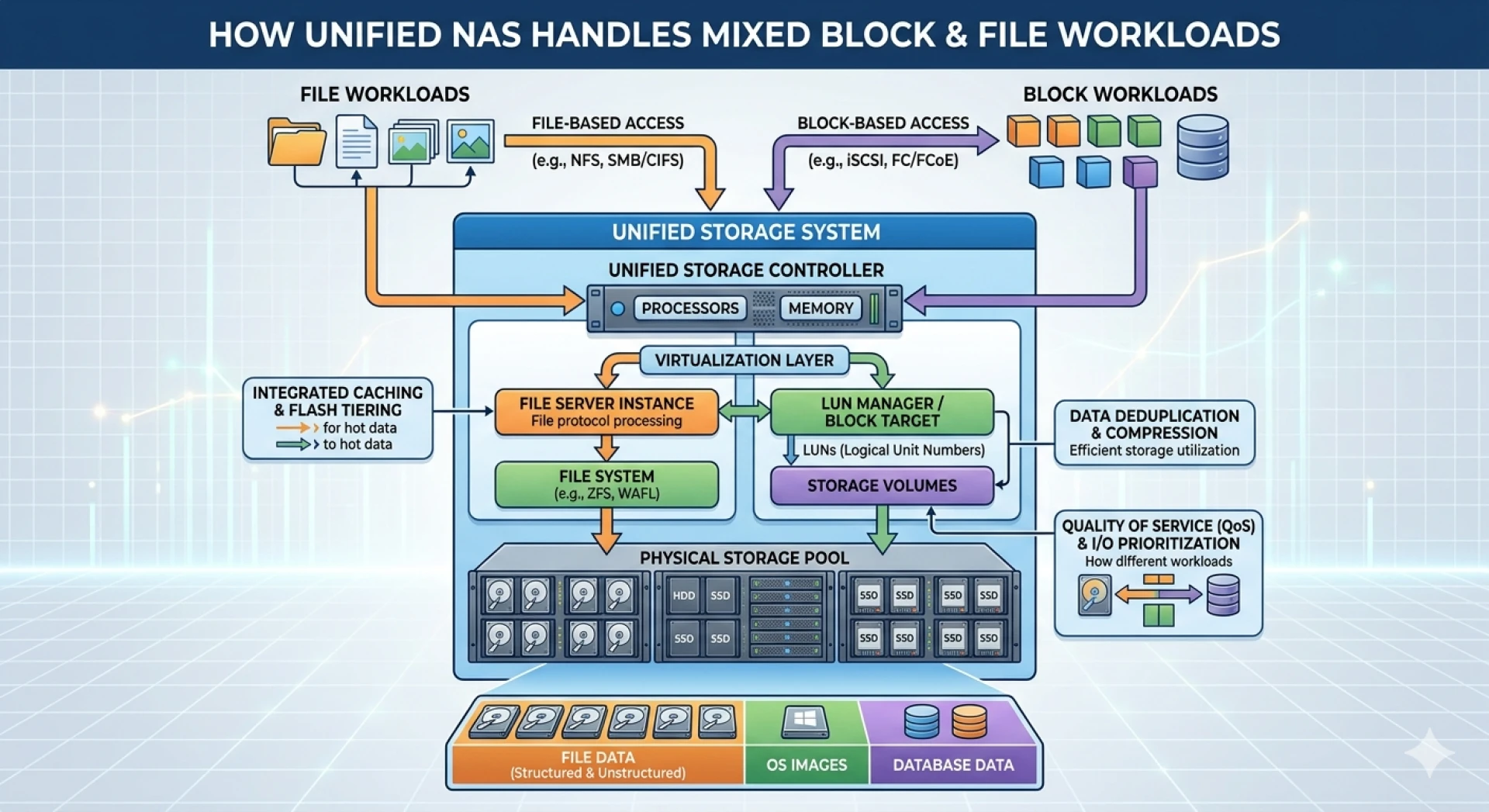
Protocol Optimization: NAS systems support multiple network protocols, allowing administrators to choose the most efficient option for each use case—whether that's NFS for Unix systems, SMB for Windows environments, or object storage protocols for cloud integration.
Performance tuning ensures that data synchronization processes don't impact the responsiveness of operational systems accessing current grid status information.
Integration with Analytics and Cloud Platforms
Data collected from smart grids feeds into analytics platforms that identify patterns, predict maintenance needs, and optimize energy distribution. NAS systems facilitate this analysis by serving as the integration point between operational data collection and business intelligence tools.
Many enterprise NAS appliances include native connectors for popular analytics platforms, simplifying data pipeline development. APIs enable custom integrations with proprietary grid management software or machine learning environments.
Cloud integration presents another important use case. Utility companies increasingly leverage cloud computing for large-scale data processing while maintaining on-premises storage for operational data. NAS systems can replicate datasets to cloud storage for analytics while keeping local copies for real-time operations—providing the benefits of both deployment models.
Building Resilient Smart Grid Infrastructure
Smart grids represent critical infrastructure that communities depend on for essential services. The storage systems supporting these networks must deliver exceptional reliability and security while accommodating massive data volumes generated by increasingly sophisticated monitoring equipment.
NAS systems provide the foundation for secure edge-to-core data synchronization that smart grid operations require. Through scalable storage, robust security features including NAS appliances ransomware protection, and flexible integration capabilities, enterprise NAS solutions address the unique challenges of managing distributed grid data.
Utility companies investing in grid modernization should evaluate how storage architecture supports both current operational needs and future expansion. The right NAS infrastructure creates a resilient data management platform that grows alongside the smart grid, protecting critical information while enabling the analytics and monitoring capabilities that define modern energy networks.


Sign in to leave a comment.